Tuesday, 5 April 2011
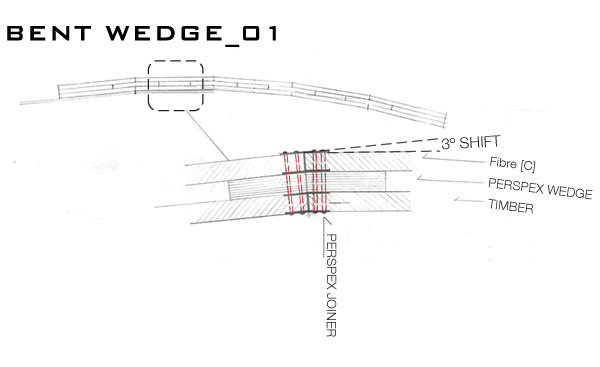
Detailing the Twist
Some early sketch designs of a perspex wedge as a joinery piece which creates a bend between each ring. Using a 3 degree shift as a starting point, the wedge allows for a bend in both the y and z direction within a single joint.

Wednesday, 30 March 2011
Monday, 28 March 2011
Case Study 03_Surface Reflection
Alphamesh: a soft yet steely metal ring mesh, made of high quality stainless steel wire. Individual rings are linked to a fully flexible metal mesh enabling pliability without compromising on durability and strength. Each individual ring is welded and guarantees the high strength stability of the metal mesh.
The case study model was created in similar fashion, in turn, mimicking the qualities that apply to alphamesh. Metal wire was soldered into rings, interlinking and woven into each other to create a skin/mesh.
The use of MDF and Plywood for our proto-type experiments proved to work very well in terms of what we set out to do: increase in scale and the effects material would have on the space. They showed great potential in that they have similar properties to the fibre C panels in regards to their rigidity and strength. All can be used as a structure like detail in a pavilion.
Perspex rods were used to hold together the MDF and plywood details, as to allow light to pass through, ultimately creating an interactive space within. It also ensures a flat finish to the structural membranes being created.
| Alphamesh: The Ring mesh |
The case study model was created in similar fashion, in turn, mimicking the qualities that apply to alphamesh. Metal wire was soldered into rings, interlinking and woven into each other to create a skin/mesh.
The use of MDF and Plywood for our proto-type experiments proved to work very well in terms of what we set out to do: increase in scale and the effects material would have on the space. They showed great potential in that they have similar properties to the fibre C panels in regards to their rigidity and strength. All can be used as a structure like detail in a pavilion.
Perspex rods were used to hold together the MDF and plywood details, as to allow light to pass through, ultimately creating an interactive space within. It also ensures a flat finish to the structural membranes being created.
Thursday, 24 March 2011
Case Study 02_The Edge
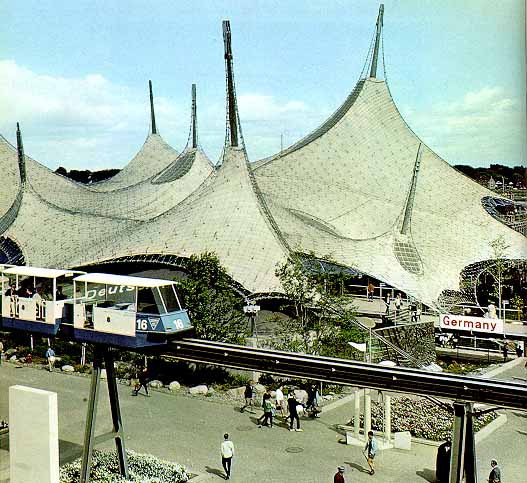
Through the exploration of the German Pavilion in Montréal, the intention was to take the same principles of a specific detail and further develop it.
The highlight we wanted to contrast is the how the detail is designed in a sense to allow the gaps/variations of two Perspex coming together whether exploring the whole edge or parts of it.
With furthering on and looking into the bend plating the effect it has on viewers not only creates a different added curve effect it also allows people to see the added simplicity of a basic framing and transforming it into a different approach.
The 3-Dimensional concept with the Perspex has allowed the potential of this pavilion to have a continous effect of layering. With the added help of the extra long bolts a clear effect of the Perspex to naturally float between the spaces. On the other hand it also creates a complete glass frameless illusion, with the added support of the small bolts, viewers would have to concentrate to really speculate the fine detail taken place.
Other effects this proto-type creates as well is the added detail of having the the Perspex to layer over each other and form a refraction development when positioned in natural day light in the outdoor environment.
| German Pavilion at Expo '67 by Frei Otto |
The highlight we wanted to contrast is the how the detail is designed in a sense to allow the gaps/variations of two Perspex coming together whether exploring the whole edge or parts of it.
With furthering on and looking into the bend plating the effect it has on viewers not only creates a different added curve effect it also allows people to see the added simplicity of a basic framing and transforming it into a different approach.
The 3-Dimensional concept with the Perspex has allowed the potential of this pavilion to have a continous effect of layering. With the added help of the extra long bolts a clear effect of the Perspex to naturally float between the spaces. On the other hand it also creates a complete glass frameless illusion, with the added support of the small bolts, viewers would have to concentrate to really speculate the fine detail taken place.
Other effects this proto-type creates as well is the added detail of having the the Perspex to layer over each other and form a refraction development when positioned in natural day light in the outdoor environment.
Subscribe to:
Comments (Atom)