Just some quick sketches of ideas for a pavilion form. Exploring ideas of an infinite spiral, a crashing wave and flowing fabric.
Also, a design for a T-Fin footing which will support our pavilion. The idea being that the fins will angle in so from the outside they will be hidden and the pavilion will appear to float above the ground. A prototype model willl be constructed over the coming days to test this concept.
Wednesday, 6 April 2011
Tuesday, 5 April 2011
Detailing the Twist
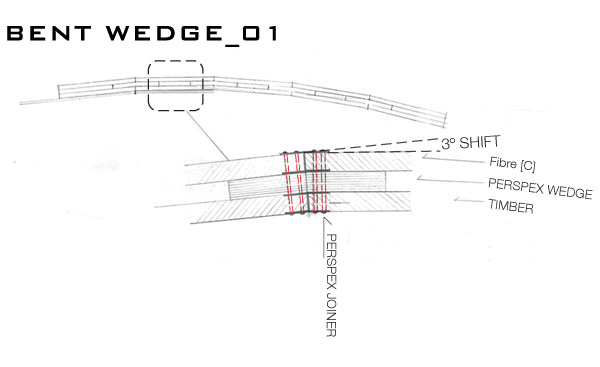
Some early sketch designs of a perspex wedge as a joinery piece which creates a bend between each ring. Using a 3 degree shift as a starting point, the wedge allows for a bend in both the y and z direction within a single joint.

Wednesday, 30 March 2011
Monday, 28 March 2011
Case Study 03_Surface Reflection
Alphamesh: a soft yet steely metal ring mesh, made of high quality stainless steel wire. Individual rings are linked to a fully flexible metal mesh enabling pliability without compromising on durability and strength. Each individual ring is welded and guarantees the high strength stability of the metal mesh.
The case study model was created in similar fashion, in turn, mimicking the qualities that apply to alphamesh. Metal wire was soldered into rings, interlinking and woven into each other to create a skin/mesh.
The use of MDF and Plywood for our proto-type experiments proved to work very well in terms of what we set out to do: increase in scale and the effects material would have on the space. They showed great potential in that they have similar properties to the fibre C panels in regards to their rigidity and strength. All can be used as a structure like detail in a pavilion.
Perspex rods were used to hold together the MDF and plywood details, as to allow light to pass through, ultimately creating an interactive space within. It also ensures a flat finish to the structural membranes being created.
| Alphamesh: The Ring mesh |
The case study model was created in similar fashion, in turn, mimicking the qualities that apply to alphamesh. Metal wire was soldered into rings, interlinking and woven into each other to create a skin/mesh.
The use of MDF and Plywood for our proto-type experiments proved to work very well in terms of what we set out to do: increase in scale and the effects material would have on the space. They showed great potential in that they have similar properties to the fibre C panels in regards to their rigidity and strength. All can be used as a structure like detail in a pavilion.
Perspex rods were used to hold together the MDF and plywood details, as to allow light to pass through, ultimately creating an interactive space within. It also ensures a flat finish to the structural membranes being created.
Subscribe to:
Posts (Atom)